
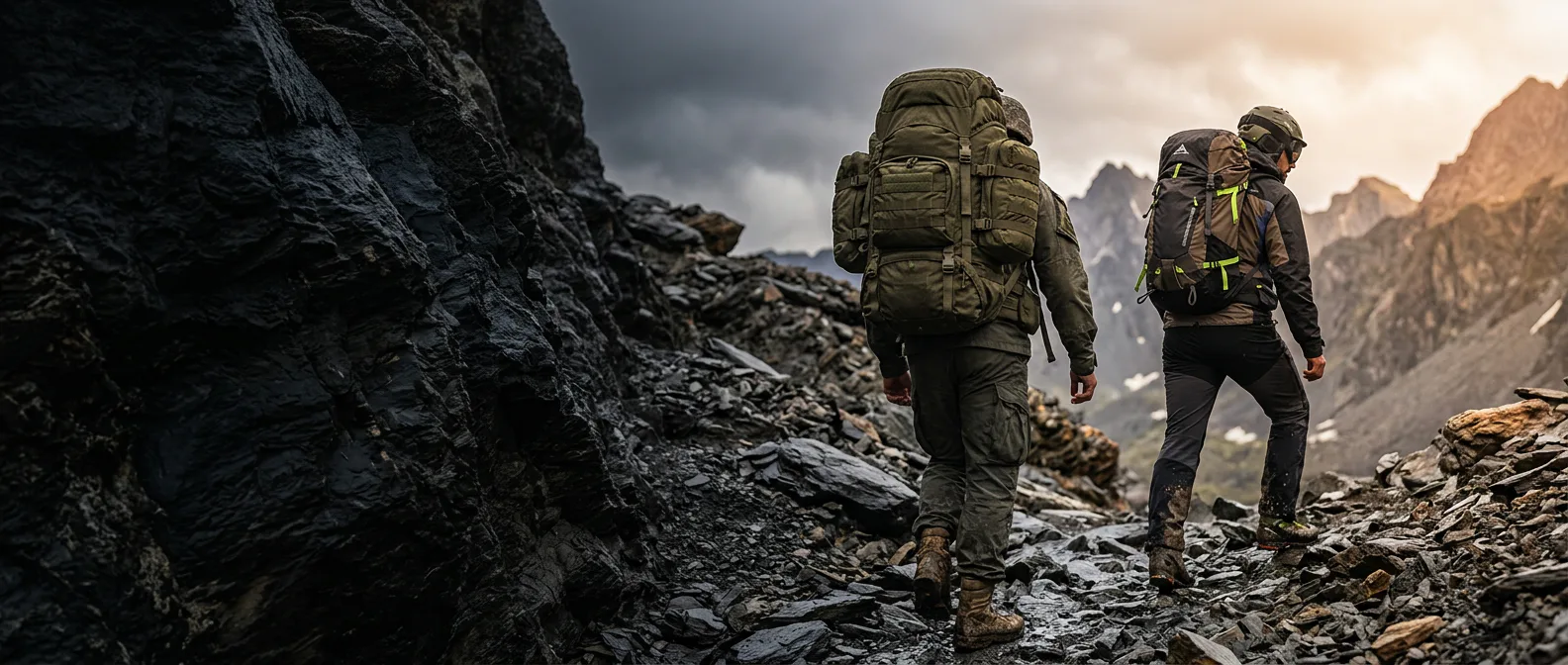
Hikers moving through rugged mountain terrain where footwear, load, motion, and time interact

Friction is only part of the story.

A foot blister is an injury produced by repeated mechanical stress. The useful question is not simply what rubbed. It is what moved, where the load concentrated, and how many times the tissue experienced it.

See the system

The interface matters.

The foot, sock, shoe, terrain, and movement pattern form one working system. Research describes friction blisters as an injury within the epidermis: repeated shear deformation can fatigue and separate cells, and fluid then fills the space.

Evidence synthesis: Journal of Athletic Training, 2024 and Current Sports Medicine Reports, 2016.

A practical interface check

Motion
Heel lift, forefoot slide, toe contact, or lateral movement.
Pressure
Fit or load concentrating force in one area.
Repetition
Steps, cuts, climbs, or hours repeating the same stress.
Environment
Moisture, heat, debris, and seams changing the interface.
Tolerance
New footwear, distance, load, or movement exceeding adaptation.

The foot moves

Bones and soft tissue shift during loading and push-off.

The interface responds

Skin, sock, and footwear resist or allow motion.

Tissue deforms

Repeated shear accumulates inside the epidermis.

A limit is reached

A small separation forms before fluid fills the space.

Where blisters form follows the movement.

Different sports change the load and motion, but the pattern stays consistent: blisters tend to appear where pressure and repeated movement converge. Start with your own history, then inspect the zones each activity stresses most.

Heel

Heel lift and repeated braking can concentrate motion at the back of the foot.

Ball of foot

Push-off, landing, pivoting, and sustained forefoot load repeat stress here.

Toes

Toe-box pressure, downhill contact, and lateral movement can load the big toe, little toe, and toe tips.

Between toes

Skin-on-skin contact and moisture can make this a repeat problem area.

Trail runner moving through dust during a forest race

Running & track

Stress pattern
Repeated heel strike and push-off over thousands of steps.
Common zones
Heels, ball of foot, big toe, little toe, and between toes.
Early response
Protect known repeat zones before the run, especially with new shoes or increased mileage.
Backpackers trekking across a rocky alpine trail

Hiking & backpacking

Stress pattern
Long exposure, uneven terrain, pack load, downhill braking, and boot contact.
Common zones
Heel backs, sides of feet, tops of toes, and the Achilles area.
Early response
Break in boots gradually, carry protection, and stop at the first hot spot when conditions allow.
Basketball players contesting a shot at the rim during an indoor game

Basketball & court sports

Stress pattern
Jumping, sudden stops, pivots, and lateral cuts inside high-grip footwear.
Common zones
Ball of foot, sides of the big toe, heel, and arch.
Early response
Check pivot zones and shoe fit before tournaments or the first week in new footwear.
Soccer players accelerating and challenging for the ball on a grass field

Soccer & field sports

Stress pattern
Cleat pressure, acceleration, cutting, kicking, and wet playing conditions.
Common zones
Heels, ball of foot, big toe, little toe, and instep.
Early response
Prioritize pre-season preparation and the dominant kicking foot when history identifies a repeat zone.
Two wrestlers grappling on a competition mat

Wrestling & combat sports

Stress pattern
Heat, sweat, mat contact, gripping, and repeated barefoot movement.
Common zones
Soles, balls of feet, toes, between toes, hands, and fingers.
Early response
Inspect between sessions and address intact-skin hot spots before more repetitions accumulate.
Ballet dancers performing under dramatic theater lighting

Dance & performing arts

Stress pattern
Forefoot loading, toe pressure, turns, repeated rehearsals, and close-fitting footwear.
Common zones
Ball of foot, toe tips, heel, and sides of feet.
Early response
Map the exact movement and costume or footwear contact that creates the repeat stress point.

A hot spot is an early signal.

Redness, warmth, stinging, or localized discomfort can precede a blister. Dermatology and first-aid guidance both recommend acting before more repetitions accumulate.

Sources: American Academy of Dermatology and Mayo Clinic.

  1. 1Stop if the activity and situation allow.
  2. 2Remove the shoe and sock; check fit, wrinkles, moisture, debris, and the exact stress point.
  3. 3Dry and clean the skin, then apply an appropriate protective covering securely.
  4. 4Reassess rather than assuming the problem is solved.

Skin intact

Prevent the blister.

Change the conditions before tissue separation progresses. Check fit, socks, exposure, moisture, and known problem areas. Adhesive moleskin is one commonly recommended option for securely protecting intact skin at a hot spot.

Blister formed

Protect the injury.

Keep the area clean and covered, preserve the blister roof when possible, and reduce additional pressure or irritation. Seek medical care for spreading redness or color change, warmth, pus, increasing pain or swelling, recurrence, or complicating conditions such as diabetes or poor circulation.

SpecOps Biosciences SkinShield Pro premium two-roll moleskin kit

Advertisement — from SpecOps Biosciences

Stop the hot spot before it becomes the day’s problem.

A paid field note about identifying repeat problem areas, protecting intact skin, and keeping prevention separate from formed-blister care.

Read field note

Sources & limits.

This page is educational and does not replace medical advice. Blister mechanisms and prevention strategies continue to be studied; recommendations can vary by person, activity, equipment, and medical history.

  1. 01Rushton & Richie, Journal of Athletic Training (2024)
  2. 02Hoffman, Current Sports Medicine Reports (2016)
  3. 03Knapik et al., Sports Medicine (1995)
  4. 04American Academy of Dermatology
  5. 05Mayo Clinic first aid guidance
  6. 06NHS blister guidance