


WHAT REALLY CAUSES BLISTERS?
Blisters aren't caused by heat, moisture, or rubbing alone. In reality the true cause of foot friction blisters is shear stress. Repetitive shear deformation of the skin layers occurs when the top layers of your skin are pulled in a different direction than the layers underneath.
This happens when the outer layer of skin of your feet grip (friction) your socks and shoes, while the rest of your inner skin layers and bones continues to move, especially during long hikes, runs, accelerations, decelerations, and repeated lateral movements. Over time, this repeated pulling causes the skin layers to separate, creating a fluid-filled pocket--a blister.
Think of it like this:If you slide your hand against a smooth floor, your outer skin wants to stick to the floor (friction) while the inner skin layers and bones within keep moving in the direction of your hand sliding on the floor. That small difference in movement between the layers? That's shear stress. And that's what causes blisters.

WHY MOST BLISTER SOLUTIONS DON'T WORK.
Many common products like bandages, gels, or petroleum jelly-try to cover or reduce "rubbing," but they miss the real issue: internal skin movement caused by shear stress.
- Bandages often shift out of place during movement
- Lubricants wear off quickly and don't stop skin layers from pulling apart
- Foam pads are too thick or soft to stabilize the skin properly
Bottom line? These products don't address the deeper mechanical forces at work.

HOW SPECOPS MOLESKIN TECHNOLOGY IS DIFFERENT.
We engineered our moleskin to do more than just stick. We use advanced material science to reduce shear strain right where blisters start: between the layers of your skin.
- Absorbs and Spreads Shear Forces
Our medical-grade moleskin acts like armor for your skin. It absorbs the pulling forces and spreads them out, so no one spot takes all the stress.
- Stabilizes Skin Movement
It adheres tightly and moves with your skin, helping to keep the upper and lower layers aligned. That means less stretching inside the skin and fewer blisters.
- Engineered for Endurance
Built for long distances, sweat, and rugged terrain, our tape stays put when others peel off or bunch up.
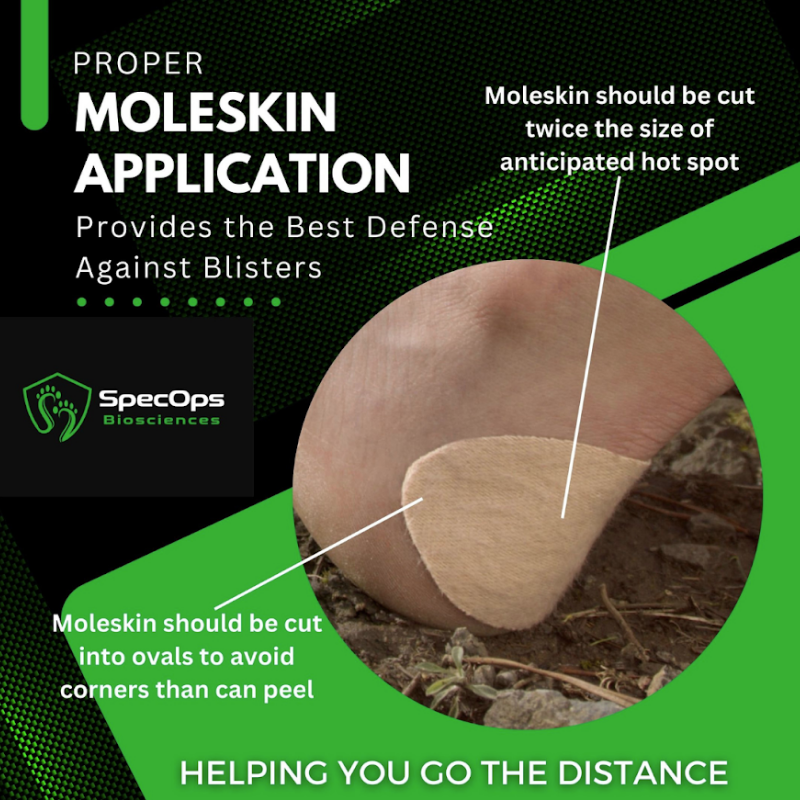
To get the best results from moleskin, first determine where you are likely to get blisters. Moleskin should be cut twice the size of anticipated hot spot. Hot spots on your feet while training are where blisters are about to form. If possible, stop training and apply moleskin before a disabling blister forms.
Provides the best defense against blisters:
- Cut an oval piece of moleskin twice the size of the hot spot
- Larger pieces of moleskin spread the shear force across a larger area, reducing the likelihood of blister formatio
- Ovals prevent corners from catching on your socks and peeling back
- Ensure the area is cleaned and free of natural oils and sweat
- Remove the backing and apply to the center of the hot spot
- Do not use moleskin on already-formed blisters.
Moleskin should be cut into ovals to avoid corners that can peel. The adhesive will stick to the roof of the blister. Already have a blister?Our hydrocolloid bandages work like a second skin - healing while vou keep crushing goals!
Backed by Research
Shear stress is the leading cause of foot blisters, especially during high-impact activities like running and hiking.
Naylor, P. F. D. (1955). The skin surface and friction. British Journal of Dermatology.
Sanders, J. E., et al. (1995). The effect of shear stress on skin. Journal of Rehabilitation Research and Development.
Rushton, R. et al (2024). Friction Blisters of the Feet: A New Paradigm to Explain Causation

Get My Free Sample of Moleskin